BLOG

Hamideh Alizadeh
January 8, 2026


But what if there was a way to make documentation faster, easier, and more efficient? What if you could use your voice instead of your keyboard or mouse? What if you could directly dictate your notes and reports to your computer or mobile device?
That's where a dictation microphone comes in. A dictation microphone is a specialized device that allows you to capture high-quality audio and convert it into text using transcription or speech recognition software. Streamlining your workflow and improving your productivity.
It can save your time, money, and hassle.
This blog post will explain what a dictation microphone is and how it works. We will also show you how a dictation microphone differs from a regular microphone, the benefits of using one for medical documentation, and how to choose the best one for your needs and budget. We will also answer some common questions and provide tips on using, comparing, and maintaining your dictation microphone.

Dictation Microphone
A dictation microphone is a device that captures your voice and sends it to your computer or mobile device. It can be wired or wireless, handheld or headset, omnidirectional or unidirectional. It can have different features such as noise cancellation, mute buttons, volume control, trackball, etc.
A dictation microphone converts your voice into an electrical signal that can be processed by transcription or speech recognition software. Transcription software converts the audio into text by matching it with a pre-recorded database of words and phrases. Speech recognition software converts the audio into text by analyzing the sound patterns and applying natural language processing algorithms.
Depending on your software, you can see the text on your screen as you speak (real-time) or after you finish speaking (offline). You can edit, format, and save the text as a document or send it to another application.
As Microsoft explains: "Dictation lets you use speech-to-text to author content in Office with a microphone and reliable internet connection. Use your voice to quickly create documents, emails, notes, presentations, or even slide notes."
A dictation microphone differs from a regular microphone in several ways. Here are some of the main differences:
| Dictation Microphone | Regular Microphone |
|---|---|
Designed to capture clear and accurate speech while filtering out background noise and interference | May pick up unwanted sounds that can affect the quality of the audio and the accuracy of the transcription or speech recognition |
Optimized for human voice frequencies and speech patterns | May not capture the nuances and variations of speech that are essential for transcription or speech recognition |
Compatible with specific transcription or speech recognition software that can recognize medical terminology and jargon | May not work well with such software or may require additional configuration or training |
Ergonomic and comfortable to use for long periods | May cause fatigue or discomfort if used for extended sessions |
Using a dictation microphone for transcription or speech recognition can offer many benefits for medical documentation. Here are some of them:
As one user said: "I love my dictation microphone! It has made my life so much easier. I can dictate my notes in half the time it used to take me to type them. I also feel more relaxed and confident in my work."
Choosing the best dictation microphone for your needs and budget can be challenging, as there are many factors to consider. Here are some of the main factors:
To help you choose the best dictation microphone for your needs and budget, you can research online, read reviews, compare models, ask for recommendations, or try different options. You can also consult a professional or an expert for advice.
This question has no definitive answer, as different dictation microphones may suit different users and situations. However, based on our research and analysis, we have selected five of the best dictation microphones in the market. Here they are:
| Name | Type | Features |
|---|---|---|
PHILIPS SMP4000 SPEECHMIKE Premium | Wireless Dictation Microphone | Studio-quality microphone, built-in triple layer noise reduction filter, decoupled free-floating microphone, integrated motion sensor, patented 100% lossless speech technology. |
Nuance PowerMic III Microphone for Dragon | Handheld USB Dictation Microphone | Mute button, volume control, trackball, etc. |
Sennheiser SC 75 USB MS | Headset Dictation Microphone | Noise cancellation, mute button, volume control, etc. |
Logitech Blue Yeti USB Microphone | USB Condenser Microphone, Multipattern | Studio-quality microphone, built-in triple layer noise reduction filter, decoupled free-floating microphone, integrated motion sensor |
Audio-Technica PRO 8HEcW Hypercardioid Dynamic Headworn Microphone | Dynamic Headworn Microphone | Hypercardioid polar pattern |
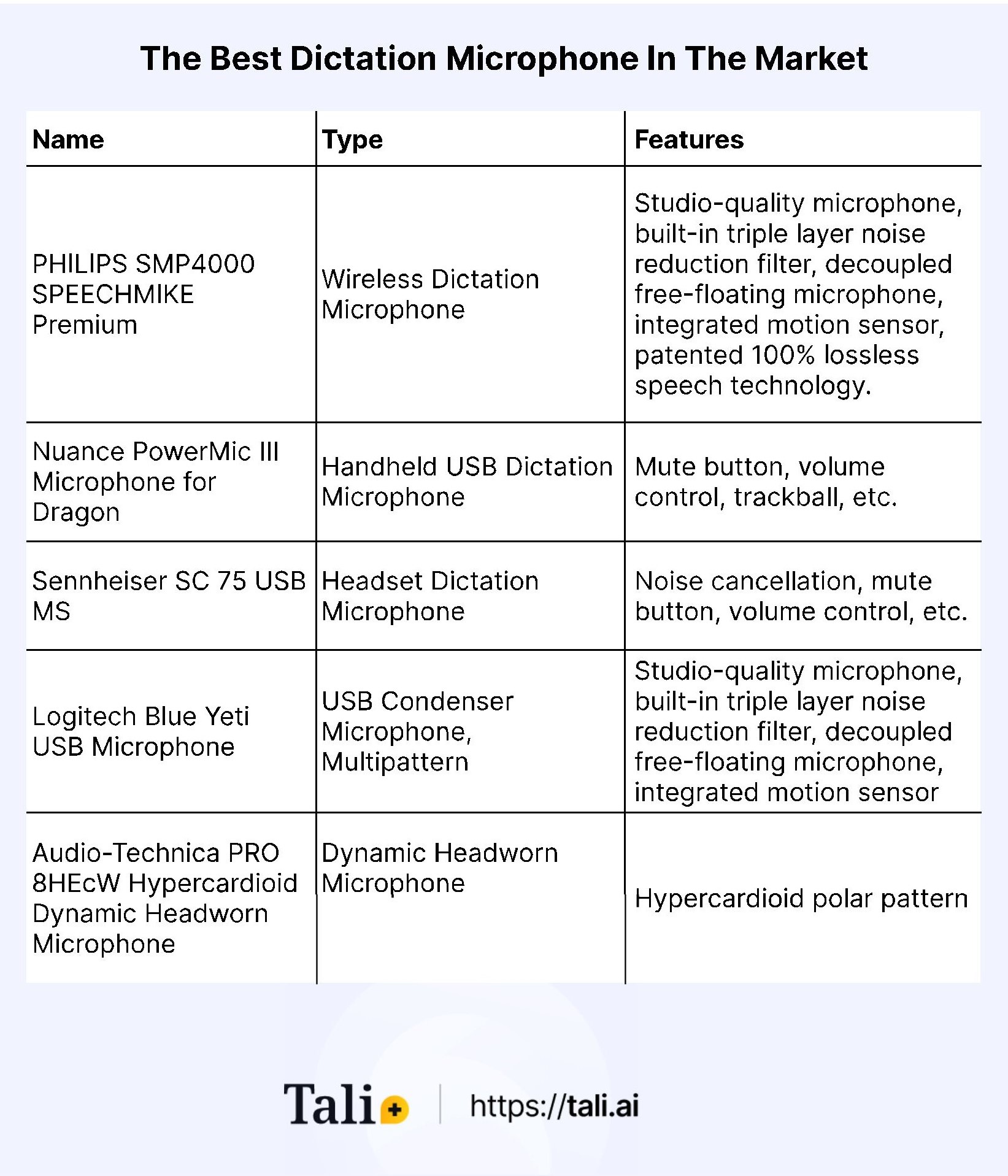
The Best Dictation Microphone In The Market
A dictation microphone can help you get the best results from your transcription or speech recognition software. Here are some tips on how to use a dictation microphone effectively:
Comparing different types and brands of dictation microphones can help you find the best one for your needs and budget. Here are some ways to compare different types and brands of dictation microphones:
You can also use online tools such as comparison charts, websites, videos, etc., to compare different types and brands of dictation microphones. You can also consult a professional or an expert for guidance.

How To Clean And Maintain Your Dictation Microphone?
Cleaning and maintaining your dictation microphone can help extend its lifespan and performance. Here are some tips on how to clean and maintain your dictation microphone:
A dictation microphone is a device that allows you to capture high-quality audio and convert it into text using transcription or speech recognition software. It can offer many benefits for medical documentation, such as saving time, improving accuracy, enhancing efficiency, increasing productivity, and boosting satisfaction.
However, choosing the best dictation microphone for your needs and budget can be challenging, as there are many factors to consider, such as type, features, quality, compatibility, and price. You can use online tools, reviews, tests, awards, etc., to compare different types and brands of dictation microphones. You can also consult a professional or an expert for advice.
Using a dictation microphone can also encounter problems affecting its functionality and usability, such as connection issues, audio quality issues, text accuracy issues, compatibility issues, etc. You can use troubleshooting tips, settings adjustments, training options, etc., to solve these problems. You can also contact customer support for assistance.
Cleaning and maintaining your dictation microphone can help extend its lifespan and performance. You can use cleaning materials, storage methods, protection measures, replacement options, etc., to clean and maintain your dictation microphone.
We hope this blog post has helped you understand what a dictation microphone is and how it works. If you are looking for a smart and easy way to use a dictation microphone for medical documentation, you should check out Tali. Tali is an AI medical dictation and ambient scribe that helps you create accurate and compliant notes and reports with just your voice. Tali works with any dictation microphone – indeed, most users just use the microphone that comes with their laptop. It also integrates with your EHR and other applications. With Tali, you can focus on your patients and let the AI do the rest. You can sign up for a free trial and see how Tali can make your life easier.
This post is published in good faith and for general information purpose only. Tali AI does not make any warranties about the completeness, reliability and accuracy of this information. Any action you take upon the information you find here is strictly at your own risk.
Tali AI is not receiving any compensation from these links or products mentioned, nor are we responsible for the content of any external websites linked to from this blog.
Experience the future of healthcare documentation with Tali's AI-powered solutions.
Related Articles

Whitepapers
October 3, 2023

Whitepapers
March 21, 2023


Research
January 8, 2026
8
Research
January 8, 2026
8
Research
January 8, 2026
8