BLOG

Haniyeh Hemmati
January 8, 2026

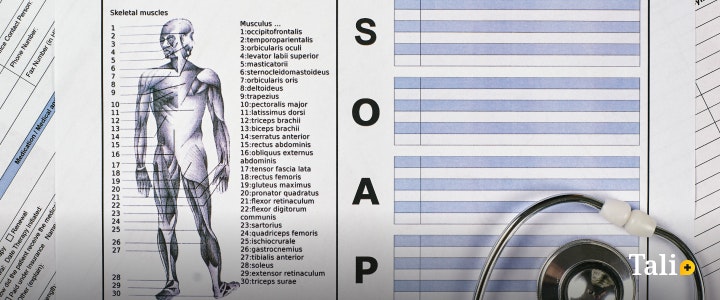
In the fast-paced world of modern healthcare, effective communication, and accurate documentation are paramount. Amidst the intricate web of medical jargon, patient histories, and treatment plans, a tool revolutionized how healthcare professionals organize and share vital information: SOAP notes. Short for Subjective, Objective, Assessment, and Plan, they are concise, structured, and standardized records of patient encounters that help clinicians track, assess, diagnose, and treat their patients. But have you ever wondered about the origins of this systematic approach, its evolution over time, and the challenges it presents in today's medical landscape?

The History and Evolution of SOAP Notes
SOAP notes were developed in the 1960s by Dr. Lawrence Weed, a physician and medical educator who pioneered the concept of problem-oriented medical records (POMR). POMR was a revolutionary approach to organizing patient information around specific problems rather than chronological events. Dr. Weed proposed that each problem should be documented using four elements: Subjective, Objective, Assessment, and Plan. These elements formed the acronym SOAP, which became the basis for SOAP notes.
These notes were initially designed for internal medicine, but soon they were adopted by other specialties and disciplines, such as nursing, psychology, physical therapy, and social work. SOAP notes became a standard format for documenting patient care across various settings and contexts.
SOAP notes are still widely used today by healthcare professionals to document patient encounters in various formats, such as paper charts, electronic health records (EHR), or voice recordings. SOAP notes serve multiple purposes, such as:
The Components and Structure of SOAP Notes
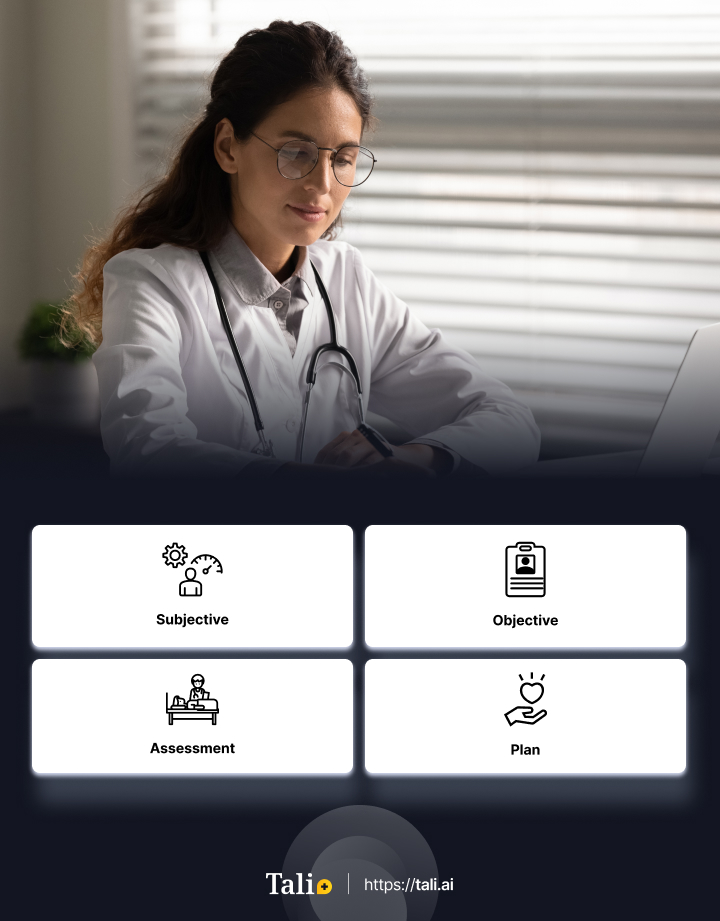
At the heart of effective patient care lies the meticulous organization of information, and SOAP notes provide a structured framework that ensures vital details are captured and communicated seamlessly. Comprising four essential components – Subjective, Objective, Assessment, and Plan – SOAP notes offer a comprehensive method for healthcare professionals to record patient interactions and treatment strategies.
The structure of SOAP notes may vary slightly depending on the clinician's specialty, setting, or preference. However, the general format is to write each component as a separate section with a heading (e.g., S: O: A: P:), followed by a narrative description or bullet points.
SOAP notes' "Subjective" component is a gateway to understanding the patient's unique perspective and experiences. This section transcends the clinical data, allowing patients to voice their concerns, emotions, and narratives. Here, healthcare providers lend an empathetic ear to the patient's chief complaints, symptoms, and medical history, unearthing essential information that might not be apparent through objective measures alone. Patients can express their discomfort, fears, and expectations, fostering a sense of partnership in their healthcare journey. The Subjective section contributes to a holistic understanding of the patient and lays the foundation for a personalized and patient-centered approach to diagnosis and treatment. By embracing the patient's story, healthcare professionals can tailor their interventions to address both the medical and emotional aspects of care, ultimately enhancing the overall quality of patient-provider interactions.
Within the domain of SOAP notes, the "Objective" component introduces an area of empirical data and measurable observations. Here, healthcare professionals transition from the patient's narrative to the realm of quantifiable information, collecting clinical findings, test results, and diagnostic assessments. Objective data is a concrete basis for informed decision-making, providing a clear snapshot of the patient's physiological state. From vital signs and laboratory values to physical examinations and imaging studies, this section enables clinicians to validate hypotheses, identify patterns, and unravel the mysteries of the patient's condition. By grounding medical insights in verifiable data, the Objective component empowers healthcare providers to craft precise diagnoses, devise targeted treatment plans, and monitor progress.
The "Assessment" component within SOAP notes is where the pieces of the patient's puzzle start to fall into place. This section serves as the juncture where subjective narratives and objective data converge, allowing healthcare professionals to synthesize information and draw meaningful conclusions. Here, clinicians analyze the presented symptoms, correlate them with objective findings, and comprehensively understand the patient's condition. The Assessment segment represents a pivotal moment of clinical reasoning, where healthcare providers navigate the medical possibilities to identify potential diagnoses or underlying issues. This analysis stage forms the basis for informed discussions with patients, shaping the dialogue around potential treatment options and future steps. By threading the patient's story together with objective evidence, the Assessment component transforms fragmented data into a coherent narrative, guiding healthcare professionals toward the most accurate and effective course of action.
Within the intricate structure of SOAP notes, the "Plan" component takes center stage as the roadmap for patient care. This section is where healthcare professionals outline the strategic steps that will guide the patient to wellness. Drawing insights from subjective experiences, objective data, and comprehensive assessment, clinicians devise a tailored plan encompassing treatments, interventions, and follow-up measures. The Plan segment bridges diagnosis and action, providing a clear blueprint for medical practitioners to follow. This component ensures that the patient's treatment trajectory is well-defined and purposeful, from prescribing medications and therapies to scheduling further tests or consultations. Additionally, the Plan section promotes continuity of care, offering a reference point for subsequent interactions and enabling healthcare providers to monitor progress and adjust strategies as needed. In essence, the Plan component elevates SOAP notes from a mere documentation tool to a dynamic framework that guides the collaborative efforts of the healthcare team toward achieving optimal patient outcomes.
SOAP notes are a useful tool for clinical documentation, but they also have challenges and limitations that can affect their quality and efficiency. Some of these challenges and limitations are:

AI Medical Scribe
In an age of rapid technological progress, the healthcare sector embraces inventive solutions to streamline operations and elevate patient care. The AI Medical Scribe harnesses the capabilities of artificial intelligence to aid in the documentation process, providing real-time transcription, analysis, and organization of patient interactions. By automating the data entry tasks that often consume valuable time, AI Medical Scribes empower healthcare providers to dedicate more attention to direct patient engagement and crucial decision-making. With the ability to precisely capture patient narratives, synthesize objective data, and even propose potential diagnoses or treatment options, this solution can revolutionize the efficiency and precision of SOAP notes, ultimately enhancing the overall quality of patient care.
An AI medical scribe can offer a solution to the challenges and constraints of SOAP notes by:
SOAP (Subjective, Objective, Assessment, and Plan) notes serve as indispensable tools in the realm of healthcare documentation. Their structured format aids healthcare providers in recording vital patient information. However, like any system, SOAP notes come with their own set of challenges and limitations that can sometimes hinder their effectiveness.
Integrating artificial intelligence (AI) into the healthcare landscape has emerged as a promising solution to addressing these challenges and limitations. AI-driven medical scribes have the potential to revolutionize the way healthcare professionals document patient encounters. By harnessing the power of artificial intelligence, these virtual assistants can streamline and enhance the entire documentation process.
In conclusion, while SOAP notes play a crucial role in healthcare documentation, they come with challenges and limitations. Embracing the power of AI through medical scribes represents a transformative solution that can enhance the quality and efficiency of documentation. With AI's assistance, healthcare professionals can streamline their workflow, improve records' accuracy, and ensure that patient information is readily accessible when and where it's needed most.
If you are looking for an AI medical scribe who can help you easily create high-quality SOAP notes, look no further than Tali. Tali is an AI-powered, voice-enabled digital assistant that streamlines administrative tasks and accesses necessary patient data from the EHR with remarkable speed and accuracy. Tali's natural language processing capability allows you to speak naturally without memorizing specific commands. As a result, you can quickly adapt Tali to your workflows and enjoy the benefits of Tali's AI medical scribe.
Tali’s AI medical scribe can help you:
Don’t miss this opportunity to transform your practice with Tali’s AI medical scribe. Experience the benefits of Tali with our free trial today!
Experience the future of healthcare documentation with Tali's AI-powered solutions.
Related Articles

Whitepapers
October 3, 2023

Whitepapers
March 21, 2023


Research
January 8, 2026
8
Research
January 8, 2026
8
Research
January 8, 2026
8